
Introduction
The emergence of AI agents capable of directly interacting with external systems via APIs (Application Programming Interfaces) marks a major technological revolution. This 'tool use' or 'functionality of tools' promises unprecedented automation, transforming how businesses operate and interact with their data. Imagine an AI agent capable of processing a customer order, generating a financial report, or modifying information in a database, all autonomously. This is the future unfolding before us. However, this power comes with a significant challenge: security. Because if an API is a bridge to your systems, an AI agent without safeguards can become an open door to unexpected risks.
At Aetherio, our expertise in custom application development in Lyon (France) daily confronts us with these challenges. As an outsourced CTO and technical partner for startups and SMBs, we design robust architectures where security is not an option, but a fundamental pillar. This article aims to guide you through the essential strategies and best practices for securing an API exposed to an AI agent. We will explore how to prevent prompt injection, implement granular permissions, sandbox potentially destructive actions, and ensure the reliability of your business systems. Prepare to transform AI's potential into a secure and controlled force for your company.
The New Risk Vector: When AI Interacts with Your Systems
Traditionally, API security focuses on direct attacks (SQL injection, XSS, DDoS, etc.) and authentication/authorization of human users or other services. The advent of AI agents, endowed with language interpretation and decision-making capabilities, introduces new complexity. They are not classic users and can present novel vulnerabilities.
Inherent Risks of API-AI Agent Interaction
Hallucinations and Unexpected Actions: Large Language Models (LLMs) are known for their ability to 'hallucinate,' meaning they generate incorrect or invented information. When an AI agent needs to choose which API function to call and with what arguments, a hallucination can translate into executing an inappropriate, or even dangerous, action. An agent meant to retrieve data could, through hallucination, attempt to modify or delete it if the API allows.
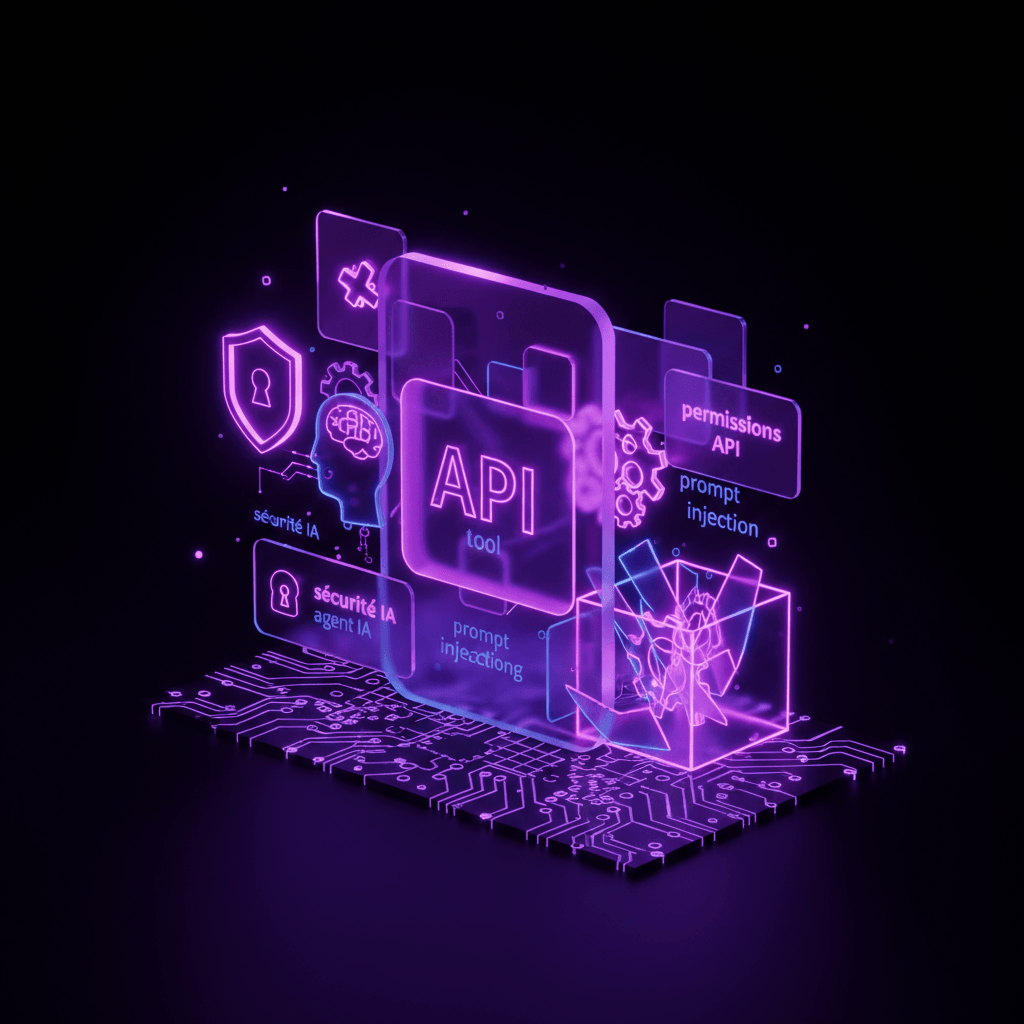
Prompt Injection: This is the most insidious threat to AI agents. It involves a malicious user manipulating the agent's behavior by injecting hidden or contradictory instructions into the prompts fed to it. The agent, designed to follow these instructions, could then bypass its initial objectives and execute unauthorized actions via APIs.
Exploitation of Excessive Permissions: If your AI agent has broad permissions on an API, a successful prompt injection attack or an unfortunate hallucination can have disastrous consequences. For example, unrestricted admin or write access is a major risk.
Sensitive Information Leakage: A malicious or compromised agent, induced by an injection, could be deliberately prompted to query API endpoints containing confidential data, then exfiltrate it via indirect channels (e.g., by including it in its responses to the user).
The Importance of a Proactive Approach
Given these challenges, a reactive security strategy is insufficient. It is imperative to adopt a proactive approach from the design stage of your architecture. This means rethinking how you expose your APIs (in French) to these new autonomous entities and implementing robust safeguards. As with traditional web application security (in French), the key lies in defense-in-depth and the principle of least privilege.
Fundamental Principles for Secure Tool Use
To build a robust architecture against AI agent risks, several design principles must be rigorously applied. These foundations ensure that even in the event of unexpected behavior or manipulation attempts, the impact on your systems remains controlled.
1. Minimal Permissions per Tool (Least Privilege)
This is the most crucial security principle: each tool (tool or function) made available to the AI agent should only have access to the resources and actions strictly necessary for its operation. Never give an AI agent administrator permissions or write access if read permission is sufficient.
Implementation:
- Fine-grained API Decomposition: Instead of exposing a generic API, create specific micro-services or API endpoints for each function the agent can call. For example, instead of a generic
POST /users, have aPOST /users/create_guestwith very limited permissions and aPATCH /users/update_profilewith different permissions. - Dedicated Roles and Scopes: Create specific authorization roles for your AI agents. These roles must have very restricted access scopes, precisely defining the endpoints, HTTP methods, and data fields the agent is authorized to interact with. A customer support agent does not need to delete user accounts.
- Argument Validation: At the API level, strictly validate arguments received from the agent. If an argument is supposed to be a numeric ID, reject any non-numeric value. This is an essential barrier against malformed data due to AI hallucinations.
2. Human Validation for High-Impact Actions
For any action with irreversible or critical consequences (data deletion, financial transactions, system configuration changes), human intervention must be required before execution. The AI agent can prepare the action, but a user must explicitly validate it.
Implementation Examples:
- Approval Workflow: The agent generates a proposed action (e.g., "delete user X's account"). This proposal is sent to an administrator via a dedicated interface (admin panel, email, mobile notification). The administrator validates or rejects the action.
- "Dry Run" Mode: Before executing a destructive or costly action, the agent can access a "dry run" mode of the API that simulates the action and returns the potential result without applying it. The agent can then present this result to the user for validation.
- History and Audit Trail: Every high-impact action attempt must be logged with the agent's identity, the initial prompt, the function called, and the arguments. This facilitates auditing and traceability in case of an issue.
3. Sandboxing Potentially Destructive Actions
Sandboxing involves isolating the agent's action execution in a controlled environment, thereby limiting potential damage in case of malicious or unexpected behavior.
Sandboxing Approaches:
- Non-Production Environments: For development and testing, have agents interact with APIs pointing to staging or development environments. This allows testing interactions without risk to production data.
- Virtualization/Containerization (Docker): APIs called by agents can be executed in isolated containers that have very limited access to the rest of the infrastructure. If a container is compromised, the impact is confined.
- Data Tokenization: For sensitive data (payment information, PII), use tokenization. The agent handles tokens rather than actual data, reducing the risk of direct leakage. This principle is particularly relevant for ensuring GDPR compliance for AI agents (in French).
4. Comprehensive Logging of Every Tool Call
Detailed logging is essential for anomaly detection, debugging, and security auditing. Every interaction of the agent with an API must be recorded.
Information to Log:
- Agent ID: Which agent initiated the call.
- Timestamp: When the call occurred.
- Initial Prompt: The user prompt that triggered the action (if relevant).
- Function Called: The name of the tool or API function used.
- Arguments: The parameters passed to the function.
- API Result: The API response (success, failure, data).
- Execution Duration: For performance analysis and detection of unusual activities.
These logs should be centralized, secured, and monitored to detect unusual access patterns or exploitation attempts.
Secure Architecture for AI Integration
For effective AI integration into your web applications (in French), implementing these principles requires a well-thought-out architecture. Here are the key components and their role in building a robust and secure system.