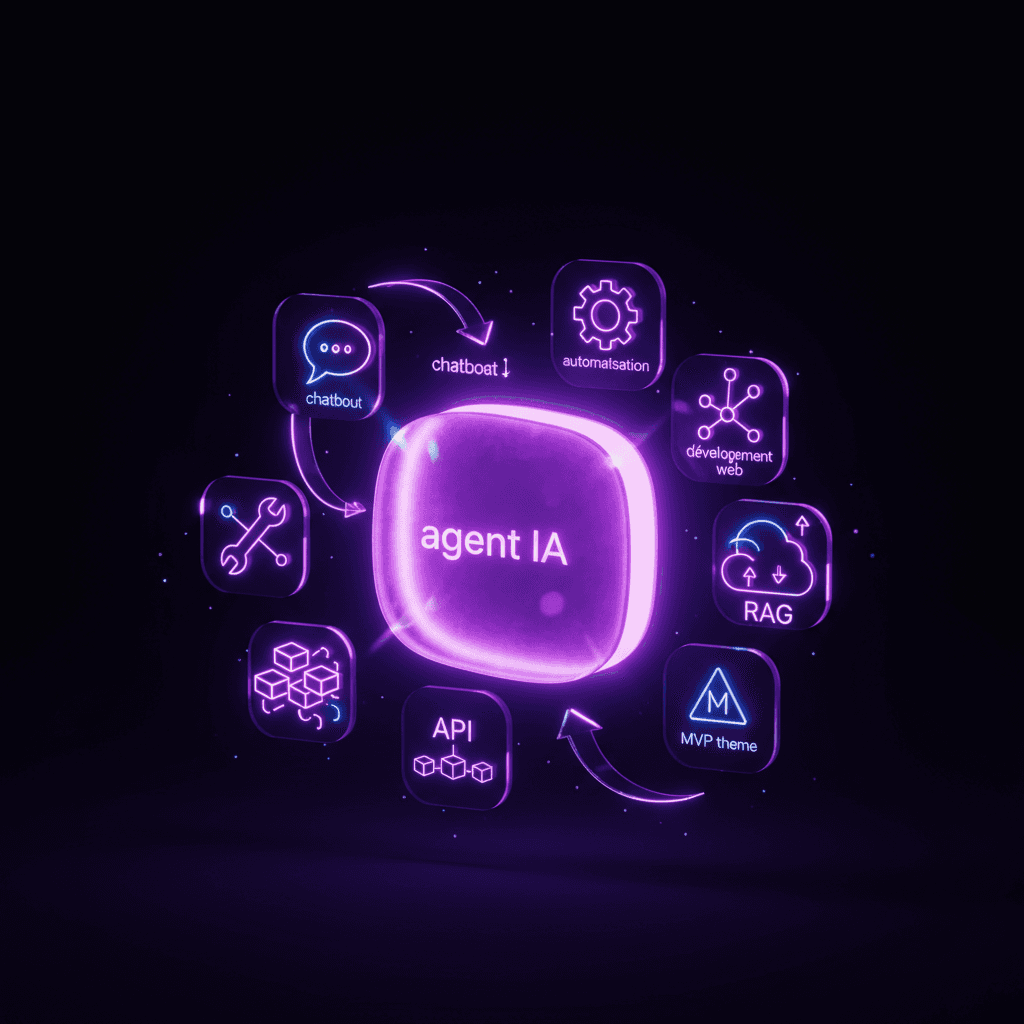
An AI agent isn't an improved chatbot. It's a system that understands, reasons and acts. It doesn't just answer a question, it solves a problem.
Your support team spends 3 hours a day answering the same questions? A RAG agent connected to your documentation answers in seconds, 24/7, with the right sources. Your sales team manually qualifies every lead? An agent analyzes the profile, scores the potential and books an appointment automatically.
This isn't science fiction. These are systems I deploy in production for my clients. AI is reliable when properly framed.
The problem with raw LLMs: they answer from their general training. They don't know your product, your processes, your customers. RAG solves this.
Data ingestion. Your documents (PDFs, web pages, databases, Notion, Google Drive) are chunked into segments, transformed into mathematical vectors and indexed. Each segment is retrievable by semantic similarity.
Intelligent search. When a user asks "how do I cancel my order", the system retrieves passages from your documentation about cancellation, even if they use different words. This isn't keyword search, it's meaning comprehension.
Sourced answers. The LLM receives relevant passages and builds its response based on them. Each answer can cite its source. If the system finds nothing relevant, it says it doesn't know instead of making things up.
Continuous updates. Your documents change, the RAG updates. New docs, new products, new procedures: the agent is always current without retraining.
The real power of AI agents is tool calling. The LLM doesn't just generate text, it uses tools.
Available tools. Each agent has access to a defined set of tools: query a database, call a REST API, send an email, create a Jira ticket, modify a CRM record. The LLM decides which tool to use, when, and with what parameters.
Multi-step orchestration. A support agent can: understand the question → search documentation → check order status in the API → propose a solution → create a ticket if unresolved → send a confirmation email. All in seconds.
Guardrails. High-impact actions (refunds, account modifications, external sends) go through human validation. The agent proposes the action, a human approves. Low-risk actions (data reads, document search) execute autonomously.
Every agent I deploy follows a proven architecture:
Structured system prompt. Identity, scope, rules, tone. The system prompt defines what the agent can do, what it must not do, and how it should communicate. Versioned in Git, tested on scenarios.
Optimized RAG pipeline. Chunking adapted to document type (paragraphs for docs, lines for FAQs). Embeddings via OpenAI or open-source models. pgvector storage in PostgreSQL or managed Pinecone.
Real-time streaming. Responses display word by word via the Vercel AI SDK. Users see the response building, not a 10-second wait followed by a text block.
Monitoring & analytics. Every conversation is logged. Satisfaction metrics, resolution rate, response time, cost per conversation. Failed conversations are analyzed to improve the agent.
Human fallback. When the agent doesn't know or confidence is low, it escalates to a human with the full conversation context. No user frustration.
AI agents aren't always chatbots. Many work in the background, without a conversational interface.
Automatic classification. Incoming emails sorted by category, urgency and department. Support tickets routed to the right team. Documents classified by type. AI does in seconds what an operator does in minutes.
Structured data extraction. A PDF invoice arrives → the agent extracts amount, date, supplier, line items → data is injected into your ERP. Zero manual entry.
Monitoring and alerting. Automatic monitoring of customer reviews, brand mentions, competitor publications. Real-time alerts when something needs your attention.
n8n + AI workflows. For visual automations, I use n8n with AI nodes. Configurable pipeline without code, modifiable by your team, self-hosted on your infrastructure.