
Introduction
Generative artificial intelligence has propelled businesses to unprecedented capabilities. However, in 2026, a major challenge persists: how to ensure that these sophisticated systems, such as large language models (LLMs), provide reliable, up-to-date information that aligns with your organization's specific context? The problem of "hallucinations" and the inability of pre-trained models to access internal and confidential data often hinder their large-scale deployment. But what if you could directly connect the power of an LLM to all the riches of your internal expertise, your documents, and your customer databases?
This is the promise of Retrieval-Augmented Generation (RAG). This innovative approach doesn't just let AI "guess" an answer; it equips it to consult your own internal and external data sources to generate accurate, relevant, and sourced responses. As a technical partner specializing in custom application development and AI automation in Lyon, France (we've got clients across North America too!), at Aetherio, we see RAG as an essential strategic lever for any company looking to integrate AI effectively and responsibly. Understanding RAG unlocks immense potential for the reliability and performance of your AI solutions. Let's explore together how this technology redefines the interaction between AI and your sensitive data.
The Problem Solved by Retrieval-Augmented Generation (RAG) in the Enterprise
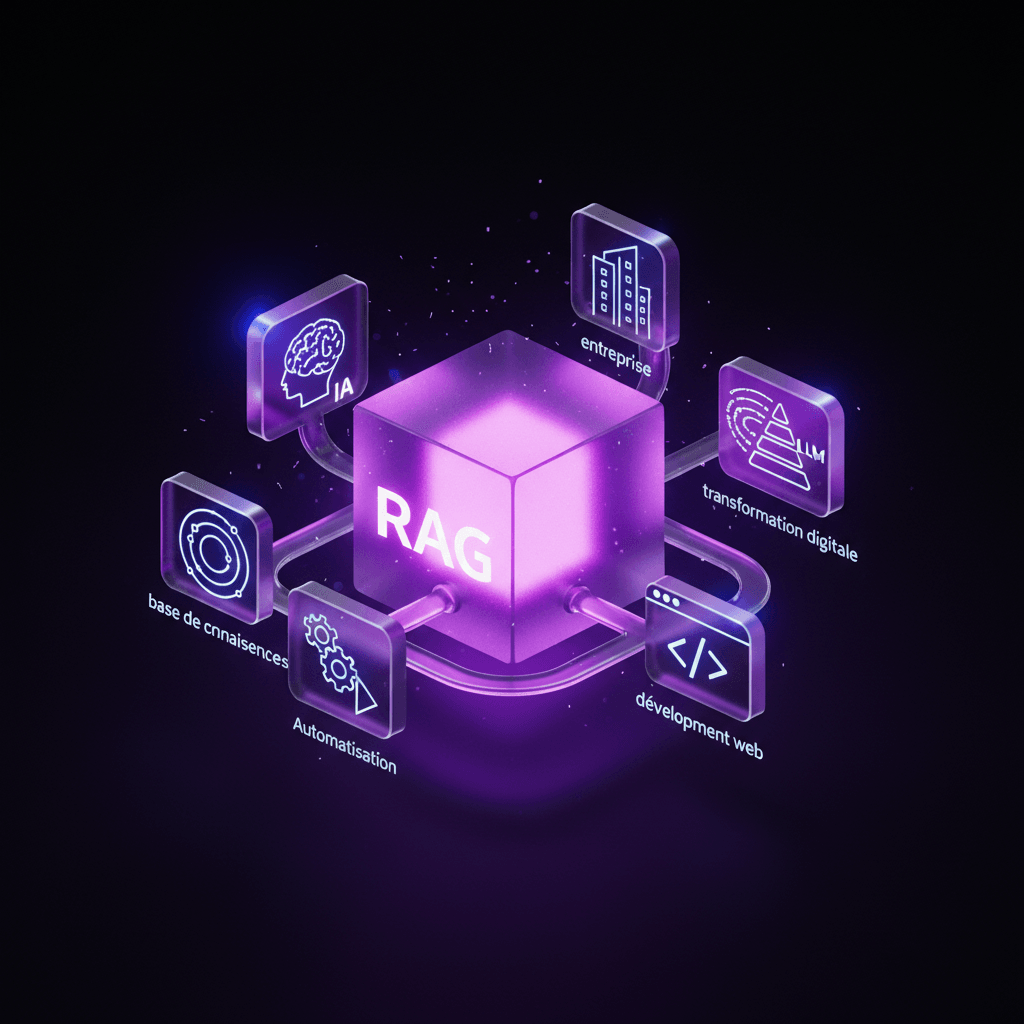
The excitement around Large Language Models (LLMs) is undeniable, and for good reason: they can understand, generate, and summarize text with impressive fluency. However, for enterprise use, these tools have significant limitations that can turn an asset into a risk, particularly in terms of information reliability and security. This is precisely where enterprise Retrieval Augmented Generation (RAG) comes in, offering a robust solution to these critical challenges.
LLM Hallucinations: A Major Challenge for Reliability
The term "hallucination" has become common to describe an LLM's tendency to generate false, invented, or misleading information, yet presented with high confidence. A pre-trained LLM has been exposed to a colossal volume of web data, but it doesn't "know" the actual meaning of what it generates. It predicts the most probable sequence, even if that sequence isn't factually accurate. For a business, inaccurate answers can have disastrous consequences: customer misinformation, operational errors, or business decisions based on erroneous premises. RAG solves this problem by grounding AI generation in verifiable facts drawn from your own knowledge bases.
Outdated Data and Lack of Specific Context
Pre-trained LLMs are frozen in time at the date of their last training. They don't have access to your market's latest information, your most recent product updates, or changes to your internal policies. This gap makes them difficult to use for questions requiring ultra-recent data or knowledge very specific to your organization. RAG allows for a continuous flow of new information, ensuring that generated responses are always up-to-date and relevant to your unique business context. This is a crucial aspect for integrating AI into your applications.
Privacy and Security of Sensitive Information
Data confidentiality is a major concern, especially in regulated sectors. Sending proprietary information, trade secrets, or personal data to a third-party cloud service for an LLM to process is often not only risky but also non-compliant. RAG addresses this by allowing AI to consult an on-premise document corpus or a secure cloud environment under your control, without this data being trained into the public model. The generated embeddings (numerical representations of data) do not reveal raw information, and the model only accesses relevant snippets, without actually "seeing" the rest of the document.
Prohibitive Training and Fine-Tuning Costs
Fully training an LLM with your own data (fine-tuning) is a resource-intensive and time-consuming operation, often costing tens or even hundreds of thousands of dollars ($10,000s or $100,000s USD). Furthermore, every data update would require costly re-training. RAG offers a much more economical and agile alternative. Instead of modifying the model, it improves how the model accesses information, a much more flexible and adaptive solution for many AI chatbot applications.
How RAG Works: From Question to Reliable Answer
The principle of Retrieval-Augmented Generation relies on a multi-stage architecture that enriches the user's query with relevant contextual information before submitting it to an LLM. The goal is to ensure that the model has the right data to formulate an accurate and verifiable response. Let's break this down step-by-step.
Step 1: Pre-indexing and Creating a Vector Knowledge Base
Even before a question is asked, the RAG system must ingest and process your vast corpus of documents (PDFs, blog posts, databases, technical manuals, etc.).
- "Chunking": Your documents are first divided into small text segments, called "chunks." The size of these chunks is crucial: they must be small enough to be precise but large enough to contain significant context. For example, a paragraph or a few sentences. This is a delicate step that directly influences the quality of retrieval.
- "Embeddings" (Vectorization): Each chunk is then transformed into a dense numerical representation, called an "embedding," using an embedding model. An embedding is a vector of numbers that captures the semantic meaning of the chunk. Two chunks with similar meaning (even if they use different words) will have "close" vectors in a multi-dimensional space.
- Storage in a Vector Database: These embeddings are stored in a vector database (such as Pinecone, Weaviate, Milvus, or even pgvector for PostgreSQL). These databases are specifically designed to efficiently store these vectors and perform ultra-fast similarity searches. This phase constitutes your internal AI knowledge base, a digital reservoir of your expertise.
Step 2: Receiving the User's Question
When a user asks a question (for example: "What is the refund procedure for a defective product?"), this question is not immediately sent to the LLM.
- Question Vectorization: The user's question itself is transformed into an embedding, in the same way as for the chunks of your documents. This creates a numerical representation of the question's meaning.
Step 3: Retrieval of Relevant Information
This is the core of RAG, the "R" in Retrieval-Augmented Generation:
- Vector Similarity Search: The question's embedding is used to query the vector database. The system searches for document chunk embeddings that are "closest" (most semantically similar) to the question's embedding. This search is extremely fast and efficient.
- Selection of the Most Relevant Snippets: The database returns a list of the
kmost relevant text fragments for the question. It's as if the AI, before speaking, consults the most relevant library for the subject. - "Re-ranking": To further refine the selection, a re-ranking model (often a small language model or a more advanced similarity model) can be used. It examines the
kretrieved fragments and reorders them according to their actual relevance to the question asked, even if their raw vector similarity was good. This helps obtain the most accurate snippets.
Step 4: Prompt Augmentation and Generation
With the most relevant snippets in hand, the system is ready to generate the answer:
- Construction of the Augmented Prompt: The prompt sent to the large language model (LLM) is no longer just the user's question. It is "augmented" (hence the "A" in Augmented Generation) with the retrieved text snippets. The prompt includes instructions such as: "Answer the following question using ONLY the text snippets provided below. If the answer is not found in the snippets, state that you cannot answer the question."
- Response Generation by the LLM: The LLM receives this enriched prompt. It uses its vast linguistic knowledge to understand the question and the provided snippets, then generates a concise, accurate response based on the contextual information. It can also cite the sources (the documents from which the snippets originated), thus increasing user confidence.
This process ensures that every LLM response is grounded in verifiable facts from your own database, drastically reducing the risk of hallucinations and guaranteeing up-to-date and relevant information.
Use Cases for Enterprise Retrieval Augmented Generation (RAG) in Business
RAG's flexibility and reliability make it a key technology for multiple business applications, impacting both internal optimization and improved customer experience. At Aetherio, we identify several concrete cases where enterprise Retrieval-Augmented Generation can transform operations.
1. Internal Conversational Agents (Chatbots) for Employees
Imagine an AI agent capable of instantly answering all employee questions regarding HR policies, internal procedures, benefits, or how specific software works. Thanks to RAG, this agent can consult:
- Human Resources manuals
- New employee onboarding documentation
- Specific software user guides
- IT support ticket databases
Benefits: Reduced workload for HR and IT departments, time savings, employee empowerment, and consistent, up-to-date answers for everyone. This improves employee experience and frees up time for support teams.
2. Dynamic FAQ and Intelligent Customer Support
RAG is a game-changer for customer support. Instead of a rigid chatbot that quickly gets lost or gives generic answers, a RAG agent can access in real-time:
- Your customer knowledge base (FAQs, help articles, guides)
- Detailed product and service datasheets
- History of resolved support tickets
- Latest product or service updates
Benefits: High-quality 24/7 (24 hours a day, 7 days a week) customer support, faster problem resolution, reduced call and email volume, and consistent responses. Customers get accurate and personalized information. This is one of the flagship use cases for AI chatbot applications.
3. Technical Documentation and Product Knowledge Base
For companies developing complex products or offering technical services, documentation management is crucial. A RAG system can query:
- Technical user manuals
- Detailed product specifications
- Test and bug reports
- Release notes and product roadmaps
Benefits: Development teams, sales representatives, or technicians can quickly access the most relevant information, accelerating diagnosis, problem resolution, and training. This makes enterprise data more reliable and helps produce concrete answers based on technical facts.
4. Analysis and Synthesis of Legal Documents and Contracts
In the legal, financial, or compliance sectors, the volume of documents is colossal. RAG can help to:
- Analyze contracts to identify specific clauses
- Summarize legislation or regulations
- Compare legal documents for discrepancies
- Assist in drafting compliance reports
Benefits: Significant time savings for lawyers and experts, reduction of human errors, faster risk detection, and better management of internal policies. This represents a major optimization lever for SaaS architecture and data management.
5. Personalized Marketing Content Generation and Sales Enablement
RAG can enrich content creation and pre-sales processes:
- Generate business proposals tailored to a prospect's specific needs, drawing information from your CRM (Customer Relationship Management) and product datasheets.
- Create help sheets, blog posts, or marketing scripts based on the latest product information or customer feedback.
Benefits: More relevant content, increased productivity for marketing and sales teams, and a hyper-personalized customer experience which, according to Aetherio's analysis, can improve conversions by 200%. Custom web application development integrating RAG enables unprecedented marketing personalization.
These examples demonstrate that enterprise Retrieval-Augmented Generation is not merely an improvement but a profound transformation in how companies can leverage their internal expertise to make AI more reliable. As an expert in custom application development, Aetherio helps you integrate AI into your applications and capitalize on these promising use cases.
Technical Stack for Deploying a Robust RAG System in 2026
Deploying an enterprise Retrieval Augmented Generation solution requires a judicious combination of tools and libraries. The AI landscape is evolving rapidly, and it is crucial to choose robust, scalable, and interoperable technologies. Here is the stack we recommend at Aetherio to build high-performance and sustainable RAG systems, congruent with 2026 standards.
1. Orchestration and Agent Frameworks: LangChain & LlamaIndex
To orchestrate the different stages of the RAG pipeline (ingestion, vectorization, retrieval, generation), frameworks like LangChain and LlamaIndex have become indispensable. They provide abstractions for:
- Integration with different LLMs (OpenAI, Claude, etc.) and embedding models.
- Management of "chains" (sequences of operations) and "agents" (LLMs capable of making decisions and using tools).
- Connection to vector databases.
These tools greatly simplify the development and maintenance of complex RAG solutions, hiding underlying complexity while offering great flexibility. At Aetherio, we use them to ensure a flexible and scalable architecture.
2. Embedding Models: OpenAI, Cohere, Sentence Transformers
The quality of embeddings is paramount for retrieval relevance. They transform your text into numerical vectors. We favor:
- OpenAI Text Embedding V3: For its performance and versatility, offering high-quality embeddings that capture the semantics of the text well.
- Cohere Embeddings: A very powerful alternative, often used for cost reasons or fine-tuned performance on certain data types.
- Sentence Transformers (Hugging Face): For more controlled or on-premise deployments, allowing the use of open-source models fine-tuned for specific use cases.
The choice will depend on the sensitivity of your data and your performance needs.
3. Vector Databases: Pinecone, Weaviate, pgvector
Efficient storage and fast searching of embeddings are essential. Vector databases are at the heart of your RAG system's AI knowledge base:
- Pinecone (Managed Service): Excellent for scalability and production performance, particularly suited for heavy workloads and teams without infrastructure expertise. It's a preferred choice for startups and scale-ups with rapid growth needs.
- Weaviate (Cloud or Self-hosted): Offers a lot of flexibility with an open-source model, allowing on-premise deployments for total data control or cloud deployments. Ideal for SMBs (Small-to-Medium Businesses) or companies desiring granular control.
- pgvector (PostgreSQL Extension): For more modest needs or when a company already uses PostgreSQL extensively. It's an open-source solution that allows adding vector database capabilities to an existing relational database, simplifying architecture and reducing costs if volumes are manageable.
The choice of your vector database will depend on your data volume, performance requirements, security constraints, and existing infrastructure.
4. Large Language Models (LLMs): OpenAI (GPT-4), Claude (Anthropic), Llama (Meta)
The generation step relies on the power of an LLM.
- OpenAI (GPT-4 Turbo, GPT-4o): Remains the benchmark in terms of reasoning and generation capabilities for general applications. Its versatility is a major asset.
- Anthropic (Claude 3 Opus/Sonnet/Haiku): An excellent alternative, often preferred for its "non-hallucination" and ability to handle long contexts, particularly relevant for enterprise Retrieval Augmented Generation.
- Meta (Llama 3): For those who want more control, reduced costs, or the ability to fine-tune internally, open-source models like Llama 3 are increasingly powerful and can be hosted on your own infrastructure.
The final LLM choice will be guided by budget, required performance, and privacy concerns (API usage versus internally hosted model).
By combining these elements with proven development practices (CI/CD - Continuous Integration/Continuous Delivery, monitoring, testing), Aetherio ensures the implementation of RAG systems that are not only performant but also maintainable and scalable, allowing our clients to truly capitalize on AI and integrate AI into their applications.
Common Pitfalls and Best Practices for Effective Enterprise RAG
While enterprise Retrieval Augmented Generation offers undeniable advantages, its implementation is not without challenges. Suboptimal choices or a poor understanding of technical nuances can reduce system effectiveness or even reintroduce problems like hallucinations. Drawing from our experience in custom web application development and AI integration, here are common pitfalls to avoid and best practices to adopt.
1. "Chunking" (Document Splitting): The Art of Granularity
Dividing your documents into "chunks" is often underestimated, but it is fundamental.
- Pitfall: Chunks that are too small may lack context, making it difficult for the LLM to understand the paragraph. Chunks that are too large can dilute relevant information, or worse, introduce irrelevant information and exceed the LLM's context window.
- Best Practice: Experiment with different chunk sizes (e.g., 200 to 500 tokens). Use intelligent splitting strategies: do not cut a paragraph or a semantic section in the middle. Consider techniques like the "recursive character text splitter" (splitting by characters then by lines/sentences) or semantic splitting. Aetherio recommends a splitting method that respects the logical structure of your documents and the objective of your enterprise LLM.
2. Embedding Quality: The Foundation of Relevance
Embeddings are the numerical representation of your text's meaning. If these representations are of poor quality, retrieval will be inaccurate.
- Pitfall: Using a generic embedding model without evaluating its performance on your specific data, or not updating it regularly. Poor quality embeddings directly lead to irrelevant information retrieval.
- Best Practice: Choose a state-of-the-art embedding model (like OpenAI
text-embedding-3-largeor Cohere) suited to your language and domain. Evaluate the performance of your embedding model on a relevant test dataset (expected questions/answers). Consider fine-tuning an open-source embedding model if you have very specific data (e.g., medical or financial technical jargon).
3. Over-indexing or Under-indexing: Your Data's Travel Ticket
Building an exhaustive AI knowledge base is the goal, but effectiveness depends on balance.
- Pitfall: Indexing too many irrelevant or low-quality documents (outdated information, duplicate data, etc.). Or, conversely, omitting crucial sources.
- Best Practice: Implement clean and continuous data ingestion processes. Clean your documents before indexing. Establish a strategy for managing the lifecycle of your data: who is responsible for updating documents, and how are these updates reflected in the vector database? Regular auditing of the vector database is essential for the performance of your enterprise LLM.
4. Re-ranking: The Crucial Refinement of Retrieval
After the first retrieval step, re-ranking can significantly improve the relevance of results.
- Pitfall: Relying solely on simple vector similarity search, which can sometimes bring back documents that are semantically close but not factually the most relevant.
- Best Practice: Integrate a re-ranking model (such as those from the
sentence-transformerspackage or dedicated services) to refine the list of retrieved chunks. This model examines more complex relationships between the question and the documents to better order them by relevance.
5. Prompt Engineering and LLM Instructions
How you phrase the prompt for the LLM is just as important as the data you provide it.
- Pitfall: Not giving clear instructions to the LLM, giving it too much freedom in its generation, or simply pasting snippets without context. This can reintroduce hallucinations or untargeted responses.
- Best Practice: Design clear and concise prompts. Explicitly instruct the LLM to answer ONLY with the provided snippets and to indicate if it cannot find the answer. Limit the LLM's response style (e.g., "short answer," "in simple language"). Consider a strict format for citations if necessary, to ensure traceability for your enterprise LLM.
By keeping these best practices in mind and avoiding common pitfalls, you will maximize the effectiveness of your RAG system and ensure that your enterprise LLM provides reliable, relevant, and compliant answers. At Aetherio, we integrate these principles into every project to ensure our clients' success with AI.
Conclusion
Enterprise Retrieval Augmented Generation is not simply a new technology; it is a fundamental approach that resolves the central paradox of generative AI in business: harnessing its unparalleled power while ensuring the reliability and relevance of information. Gone are embarrassing hallucinations, outdated data, and privacy fears. RAG offers you the key to connecting your internal expertise, often scattered and underutilized, directly to the cognitive capabilities of LLMs.
By implementing a RAG system, you radically transform how your company interacts with information. From improving customer support to accelerating internal research, and optimizing complex business processes, the use cases are vast and the benefits measurable: time savings, cost reduction, improved decision-making, and increased confidence in the AI tools that support your operations.
At Aetherio, we see RAG as a pillar of digital transformation in 2026. Our expertise in custom application development, strengthened by our mastery of RAG architectures and best technical practices (LangChain, vector databases, LLMs), ensures a successful deployment tailored to your strategic goals. We don't just build the technology; we help you build the strategy to integrate it successfully and maximize your ROI.
Don't wait for your competitors to capitalize on this innovation. Your internal expertise is your greatest asset. Transform it into an inexhaustible source of reliable answers through Retrieval-Augmented Generation. Contact Aetherio today to explore how we can bring your RAG project to life and make AI a truly reliable growth partner for your business.
Further Readings:
- AI in a Web Application: 8 Concrete Cases and Technical Guide 2026
- SaaS Architecture: Complete Guide to Mastering Data Management and Strategic Challenges in 2026