Introduction
Dreaming of launching your own Software as a Service (SaaS), but held back by technical and strategic complexity? By 2026, the SaaS market is more mature than ever, but also more competitive. According to Statista, global SaaS market revenue is projected to reach $347.7 billion in 2024, with an annual growth rate of 13.88%. This presents an immense opportunity, but it demands a methodical and expert approach to successfully create a SaaS from scratch.
This article is your comprehensive guide to transforming an idea into a profitable and scalable SaaS solution. We'll demystify every crucial step, from validating your concept and selecting the best technical stack, to deployment and launch. With our expertise in complex web application development and designing robust architectures, we provide you with the keys to navigate this technological and commercial landscape. Get ready to launch a product that not only solves a real problem but also generates sustainable revenue. Let's get started building your SaaS from A to Z!
1. Idea Validation: The Foundation of Every Successful SaaS
Before diving into code and architecture, the first—and most critical—step to create a SaaS is meticulously validating your idea. Without a deep understanding of the problem and the market, even the best technology won't suffice. According to a CB Insights study, lack of market need is the primary reason startups fail (35%).
Identify a Real Problem and Target Market
Your SaaS must solve a painful and recurring problem for a specific market segment. Don't start with a solution; start with a problem. Who is affected by this problem? How significant is this pain? Have they tried other solutions unsuccessfully?
- Define Your Ideal Customer Profile (ICP): Who are they? What are their demographic and psychographic characteristics? What are their goals and frustrations?
- Quantify the Problem: How much time, money, or effort does this problem cost your target audience? The greater the pain, the more value your solution will have.
- Market Size: Evaluate the Total Addressable Market (TAM), Serviceable Available Market (SAM), and Serviceable Obtainable Market (SOM). A niche market can be highly profitable if the problem is acute.
Competitive Analysis and Differentiation
Almost no market is completely untapped. Your competitors are not just other SaaS applications but also existing workarounds (spreadsheets, manual processes, other software). The goal is to understand where you can stand out.
- Identify Direct and Indirect Competitors: What are their strengths and weaknesses? What are their pricing models?
- SWOT Analysis: Strengths, Weaknesses, Opportunities, Threats for you and your competitors.
- Your Unique Value Proposition (UVP): What will make your SaaS fundamentally better or different? Is it better UX, fairer pricing, a missing feature, deeper integration, specific expertise?
Validate the Idea with Users
Talk to your future users as early as possible. Don't rely on assumptions.
- Exploratory Interviews: Open-ended discussions to understand their challenges.
- Targeted Surveys: To validate hypotheses on a larger scale.
- Landing Page + Waiting List: Create a page presenting your concept to gauge interest (with email capture).
- MVP (Minimum Viable Product): The objective is to build the smallest version of your product that delivers value and allows you to gather real feedback. Keep the "lean startup" principle in mind: Build, Measure, Learn.
2. Business Model: Pricing and Key Metrics
Your SaaS's success depends as much on its technology as on its ability to generate revenue. A solid business model is crucial for your company's sustainability and growth. This phase helps you create a SaaS that is not only functional but also profitable.
SaaS Pricing Strategies
Choosing the right pricing model is complex. It must reflect the value you provide and be understandable to your customers.
- Per User: Simple and predictable, but can limit team adoption.
- Per Feature (Tiered): Offers different packages (Basic, Pro, Enterprise) with more features or capabilities.
- Usage-Based (Pay-as-you-go): Based on the number of actions, storage, API calls. Ideal if usage varies significantly.
- Value-Based: Pricing is directly tied to the ROI the customer achieves (e.g., percentage of generated savings).
- Freemium vs. Free Trial:
- Freemium: A permanently free version with limited features or usage. Generates leads, but conversion rate must be sufficient.
- Free Trial: Full product access for a limited time (e.g., 7 or 14 days). Often converts more engaged users.
Essential SaaS Metrics
To drive your SaaS growth, you'll need to track key performance indicators (KPIs):
- MRR (Monthly Recurring Revenue) & ARR (Annual Recurring Revenue): The most fundamental metrics.
- Churn Rate: The percentage of customers who cancel their subscription over a given period. Low churn is vital.
- CAC (Customer Acquisition Cost): The average cost to acquire a new customer. Must be lower than your LTV.
- LTV (Lifetime Value): The total revenue a customer will generate throughout their lifetime with your service. Ideally, LTV > 3x CAC.
- Conversion Rate: Percentage of users moving from one status (visitor, freemium, trial) to another (paid).
- ARPU (Average Revenue Per User): Average revenue generated per user.
3. Technical Architecture: The Foundations of Your SaaS
Architecture is the backbone of your SaaS. Well-designed, it ensures scalability, security, and maintainability. Poor SaaS architecture can lead to exorbitant costs and insurmountable limitations. To create a high-performing SaaS, anticipation is key.
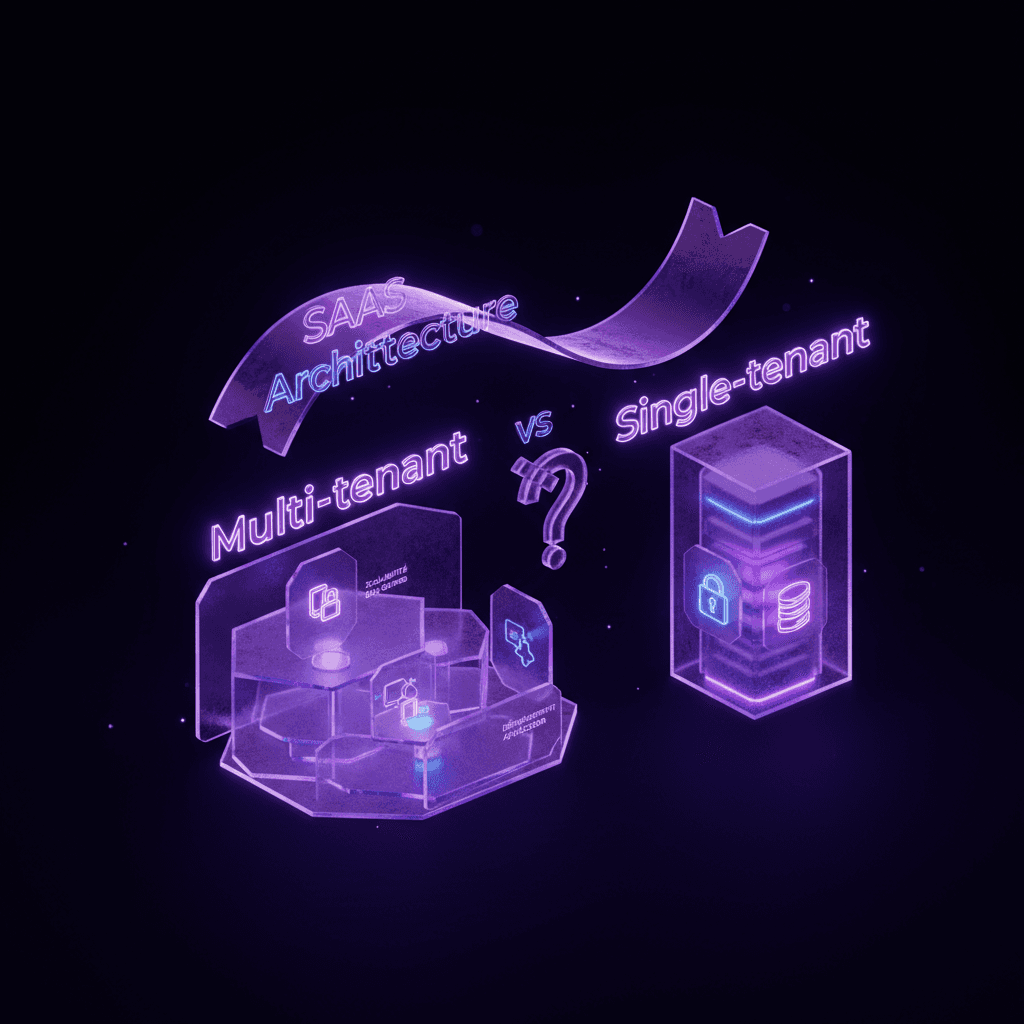
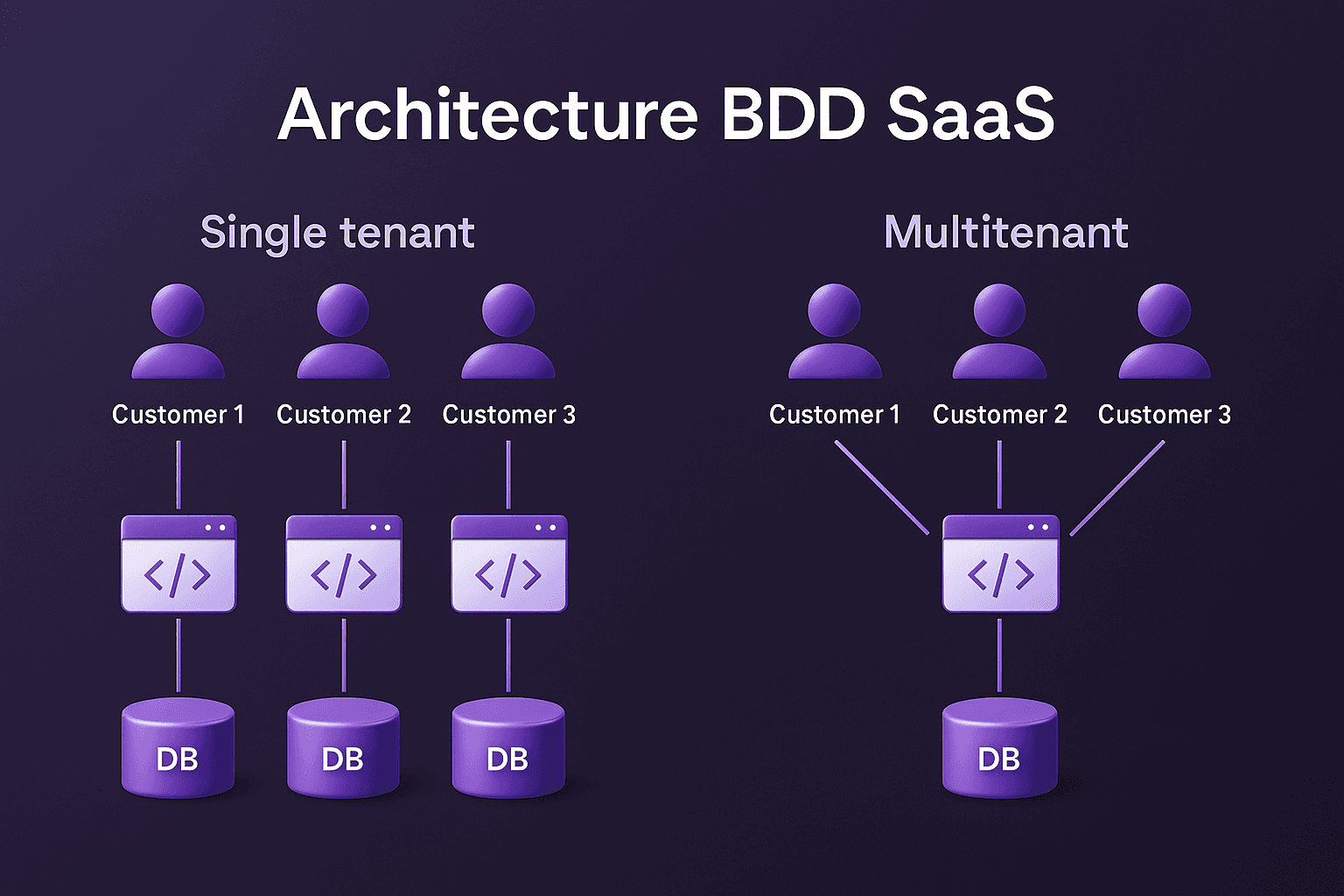
The Crucial Choice: Multi-tenant vs. Single-tenant
- Multi-tenant: All customers share the same software instance and database, but their data is logically isolated. This is the most common model for SaaS as it's more cost-effective to maintain and scale. It's the essence of SaaS.
- Single-tenant: Each customer has their own instance of the application and database. More costly and complex to manage (separate deployments, updates), but offers maximum isolation and customization. Generally reserved for enterprise clients with specific compliance or performance requirements.
For most startups looking to create a SaaS from scratch, the multi-tenant model is the way to go.
Key Principles for Any Application Development
- API-First: Design your backend as a RESTful or GraphQL API. Your frontend, mobile apps, and any external integrations will consume this API. This ensures a decoupled architecture and facilitates evolution.
- Microservices vs. Monolith:
- Monolith: A single codebase for all features. Faster to develop initially, ideal for an MVP. But it can become complex to maintain and scale as the product grows.
- Microservices: The application is divided into small, independent services, each responsible for a specific function. More complex to set up (DevOps, monitoring), but offers great scalability and long-term resilience. For your first SaaS build, a well-structured monolith or modular architecture is often preferable.
- Queue Management: For long or resource-intensive tasks (sending emails, file processing, report generation), use message queues (e.g., Redis Queue, RabbitMQ, SQS). This offloads the main server and improves application responsiveness.
- Caching: Cache frequently accessed data (e.g., Redis). This reduces load on the database and speeds up your application's response times.
- High Availability & Resilience: Your SaaS must always be available. Plan for redundant servers, regular backups, and a disaster recovery strategy.
Example of a SaaS Application Implementation
At Aetherio, we had the opportunity to work on the case study Fideneo, a SaaS Application - CRM for Salons. This real-world experience highlights the technical challenges and solutions for developing a robust platform tailored to specific industry needs.
4. Technical Stack: Choosing the Right Tools to Create a SaaS
Your technical stack choice is fundamental to your SaaS's performance, scalability, and maintainability. In 2026, many modern and proven options are available. To create a SaaS with a solid, scalable foundation, adopting recent technologies is an asset.
Frontend: User Interface
- Vue.js 3 / Nuxt.js: A progressive JavaScript framework, lightweight and performant. Nuxt.js, built on Vue, adds Server-Side Rendering (SSR), SEO optimization (critical for Growth Hacking), and a robust project structure, ideal for complex applications and SaaS. This is the stack we favor at Aetherio for its development speed and performance. If you need experts for your Vue/Nuxt development in Lyon, don't hesitate.
- React / Next.js: A very popular and mature alternative. Next.js offers similar advantages to Nuxt for SSR and performance. The choice between Vue/Nuxt and React/Next.js often comes down to team preference or existing skills. Our Nuxt.js and Vue.js team can help you navigate this crucial decision.
- Tailwind CSS: A utility-first CSS framework that allows for building modern, responsive designs very quickly, without leaving your HTML. Essential for accelerating front-end development and ensuring design consistency.
Backend: The Application's Core
- Node.js / Nest.js: Node.js allows using JavaScript on the server-side, which is highly efficient for Full Stack teams. Nest.js is a TypeScript-based Node.js framework offering a solid architecture (inspired by Angular), excellent modularity, and scalability. Ideal for building robust, maintainable APIs.
- Python / Django or FastAPI: Python is a highly versatile language, particularly valued for data analysis and AI. Django is a very mature "batteries included" web framework, while FastAPI is more modern and lightweight, offering exceptional performance for APIs.
Database and Cache
- PostgreSQL: The go-to open-source relational database. Robust, performant, supports advanced features, and is extremely reliable. Essential for your SaaS's structured data.
- MongoDB (or other NoSQL): For unstructured data or specific use cases (e.g., event logs, monitoring data), a NoSQL database can be a good complement.
- Redis: An in-memory key-value data store, ultra-fast. Essential for caching (request acceleration), session management, WebSockets, and message queues (as discussed earlier).
Payment and Billing
- Stripe: The most popular payment platform for SaaS. Easy to integrate, handles subscriptions, recurring payments, and offers an excellent API. A must-have.
Email Sending
- Resend (or SendGrid, Postmark): Reliable transactional email sending services. Crucial for signup confirmations, notifications, password resets, etc. Ensure good deliverability.
DevOps and CI/CD
- Docker / Kubernetes: For containerizing your applications and managing their deployment in a scalable and portable way. Kubernetes is complex but essential for large-scale microservices architectures. Docker is an excellent starting point.
- AWS / GCP / Azure: Leading cloud providers. Offer a multitude of services for hosting, scaling, and securing your SaaS. Choose the one that best fits your needs and budget.
- GitHub Actions / GitLab CI/CD: Continuous Integration and Continuous Deployment tools. Automate your tests, builds, and deployments to ensure a fast and reliable development cycle.
5. The MVP: Minimum Viable Product
The MVP (Minimum Viable Product) concept is vital for creating a SaaS efficiently and within budget. It involves building the version of your product that contains only the essential features to solve your early users' core problem and gather their feedback.
What to Include and What to Cut for the MVP
The most common mistake is wanting to launch a "perfect" product with too many features. An MVP isn't an incomplete product; it's a product that solves a unique problem with maximum effectiveness. Think of the Pareto principle: 20% of features deliver 80% of the value.
To Include:
- The core functionality that solves the main problem.
- Simple and quick onboarding: The user should be able to test the value quickly.
- A basic authentication system: Signup, login, password recovery.
- An integrated feedback mechanism: Allow users to report bugs or suggest improvements.
- Basic metrics to measure engagement and usage.
To Cut:
- "Nice-to-have" features: Anything not absolutely essential for the core problem.
- Excessive customization: Keep configuration options to a minimum.
- Complex integrations: Add them gradually based on demand.
- Advanced reports and dashboards: Start with simple views and exports.
- Multilingual support: Unless your target market is inherently international from the start.
Aetherio's Approach to a Successful MVP
At Aetherio, we specialize in helping startups and SMEs create functional and scalable MVPs. We follow an agile methodology to ensure your product meets market needs while optimizing your initial investment. Every web application development step is designed for ROI.
6. Authentication and Security: Trust is Key
In a SaaS environment, security isn't an option; it's a fundamental requirement. User management and data protection are paramount to maintaining customer trust and complying with regulations (like GDPR). To create a reliable SaaS, you must integrate security from the design phase.
User Management and Roles
- Strong Authentication: Implement robust authentication methods (Secure passwords, Two-Factor Authentication MFA/2FA, or even passwordless authentication).
- SSO (Single Sign-On): For enterprise clients, SSO (with providers like Okta, Auth0, or SAML/OAuth2 integrations) is a highly valued feature that simplifies login and enhances security.
- RBAC (Role-Based Access Control): Define clear roles (admin, editor, viewer, etc.) and assign specific permissions to each role. This ensures users only access the features and data they are authorized for.
Data Security
- Data Encryption: Encrypt sensitive data at rest (in the database) and in transit (via HTTPS/SSL).
- Access Management: Limit access to databases and infrastructure to only those individuals and services that strictly need it (principle of least privilege).
- Regular Backups: Implement an automatic backup strategy and regularly test restoration to ensure your data is recoverable in case of issues. GDPR compliance requires proof of restorability.
- Security Audits: Conduct regular security audits (pen-tests, code audits) by external experts to identify and fix vulnerabilities.
7. Deployment and Operations: Going Live and Monitoring
Once your MVP is developed, it's time to make it accessible to your users. Deployment and operations management are crucial steps to ensure your SaaS's optimal availability and performance.
Continuous Integration and Deployment (CI/CD)
- CI (Continuous Integration): Every code change is automatically tested (unit, integration tests) to catch errors early. Tools like GitHub Actions or GitLab CI/CD are essential.
- CD (Continuous Deployment/Delivery): Once tests pass, the code is automatically deployed to production (or a staging environment). This enables fast, reliable updates, minimizing the risk of human error. This approach is detailed in our Comprehensive Web App Development Guide.
Monitoring and Alerting
- Performance Monitoring: Track key application performance metrics (response time, CPU load, memory usage, errors). Tools like Prometheus, Grafana, Datadog are commonly used.
- Log Management: Centralize logs from your application and infrastructure to simplify debugging and problem analysis. Elasticsearch, Logstash, Kibana (ELK Stack) or Grafana Loki are popular solutions.
- Alerting: Set up alerts to be notified instantly of issues (critical errors, service outages, threshold breaches). Reactivity and resilience are key.
8. Launch and Growth: Acquiring Your First Users
Your SaaS is ready. It's time to present it to the world! Launching isn't an end goal; it's the beginning of a continuous cycle of acquisition, retention, and iteration.
Launch Strategy
- Alpha/Beta Phase: Launch to a select group of users (often from your waiting list) to get valuable feedback and refine the product before a public launch. You need a well-established feedback loop.
- Public Launch: Prepare a solid marketing and communication strategy. Press releases, social media, blog posts, paid advertising (Google Ads, LinkedIn Ads) are all levers.
- SEO and Content: Optimize your website for search engines. Create valuable content that educates your prospects and solves their problems, using keywords like "create a SaaS from scratch."
Acquisition and Retention
- User Onboarding: A smooth onboarding process is essential to convert trials into paying customers. Tutorials, interactive guides, and responsive support make all the difference.
- Continuous Feedback Loop: Keep collecting user feedback (surveys, interviews, usage analysis) to identify areas for improvement and new features to develop.
- Marketing and Sales: Deploy content marketing, email marketing, paid campaigns, and direct sales strategies to attract new customers.
- Customer Success: Invest in a dedicated customer success team (or person). A satisfied customer is a customer who stays and recommends your product.
Conclusion
Creating a SaaS from scratch is an exciting but demanding adventure. It requires a clear vision, rigorous technical execution, and a deep understanding of the market. From idea validation to selecting the ideal technical stack, setting up a robust SaaS architecture, and strategic launch, each step is a milestone towards success.
The challenges are numerous: identifying a critical problem, building an effective MVP, ensuring data security, deploying with agility, and acquiring and retaining your first users. But with a methodical approach and the right expertise, you can turn your vision into a profitable reality.
At Aetherio, we are more than just service providers; we are your strategic technical partners in bringing your SaaS ambitions to life. Whether you're a startup looking to launch its MVP, an SME aiming to automate processes with AI, or a scale-up seeking a resilient architecture, our team in Villeurbanne (Lyon) is ready to support you. We bring our Full Stack expertise, CTO vision, and mastery of modern technologies to build custom, high-performance, and scalable web applications.
Ready to transform your idea into a successful SaaS in 2026? Contact Aetherio today to discuss your project and benefit from cutting-edge technical expertise.
Further Reading:
- SaaS Architecture: A Complete Guide to Mastering Data Management and Strategic Challenges in 2026
- How to Choose Your Technical Stack in 2026
- Web Application Development: 9 Key Steps (2026)