
Introduction
Launching a SaaS and wondering how to structure your application to welcome your first customers? The choice between a multi-tenant and single-tenant architecture is one of the most critical technical and strategic decisions. According to a 2024 Flexera study, over 70% of modern SaaS vendors opt for some form of multi-tenancy, but that doesn't mean it's the ideal solution for everyone.
In my experience as a Partner CTO at Aetherio, I've guided over a dozen SaaS startups through this strategic choice. The consequences are profound, impacting infrastructure costs, maintenance efforts, customization capabilities, data security, and ultimately, your product's profit margin and commercial success. This article offers a detailed, data-driven, and practical comparison of both models, helping you make an informed decision based on your market, regulations, and growth objectives.
Multi-tenant vs. Single-tenant: Definitions and Basic Principles
What is a Multi-tenant SaaS Architecture?
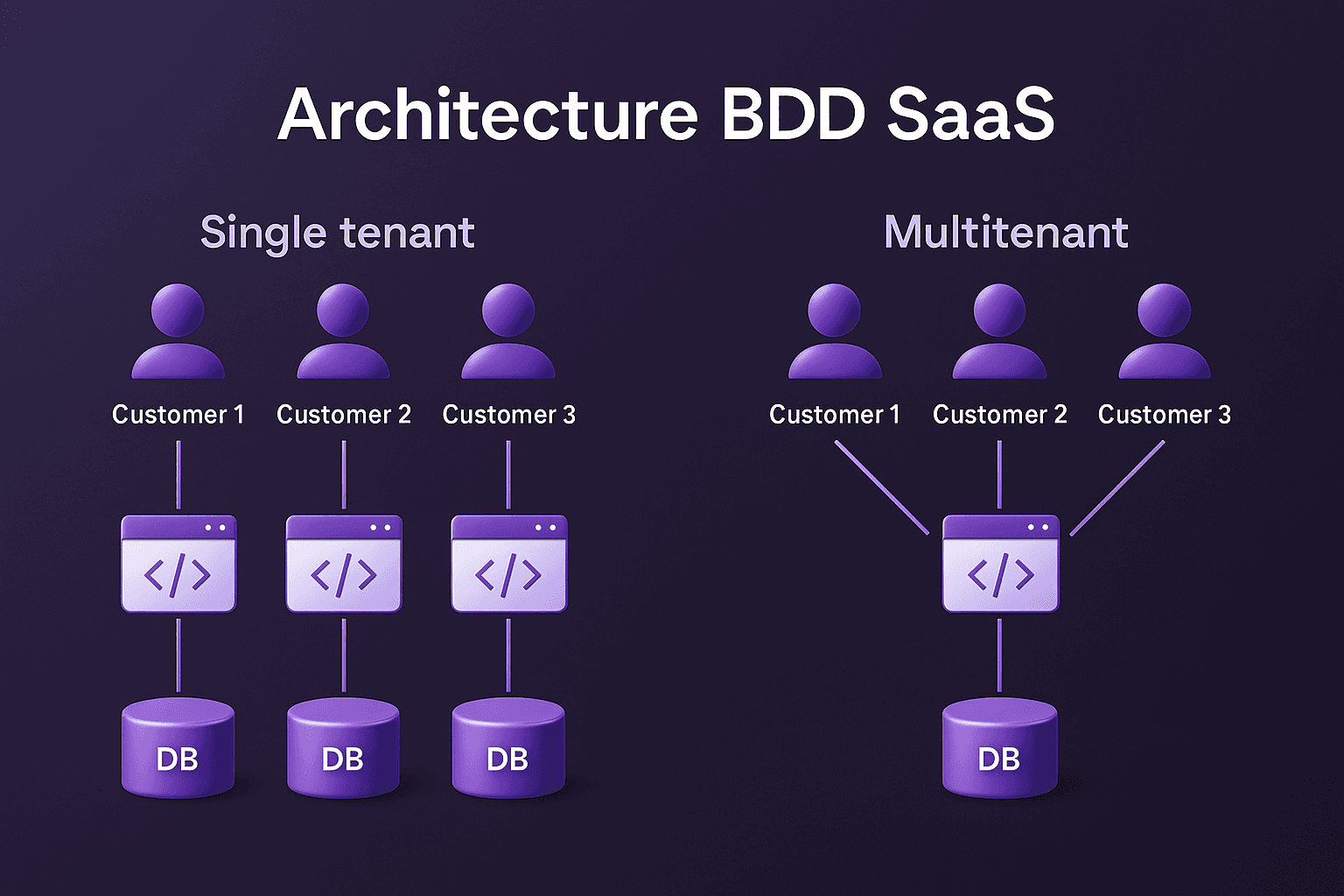
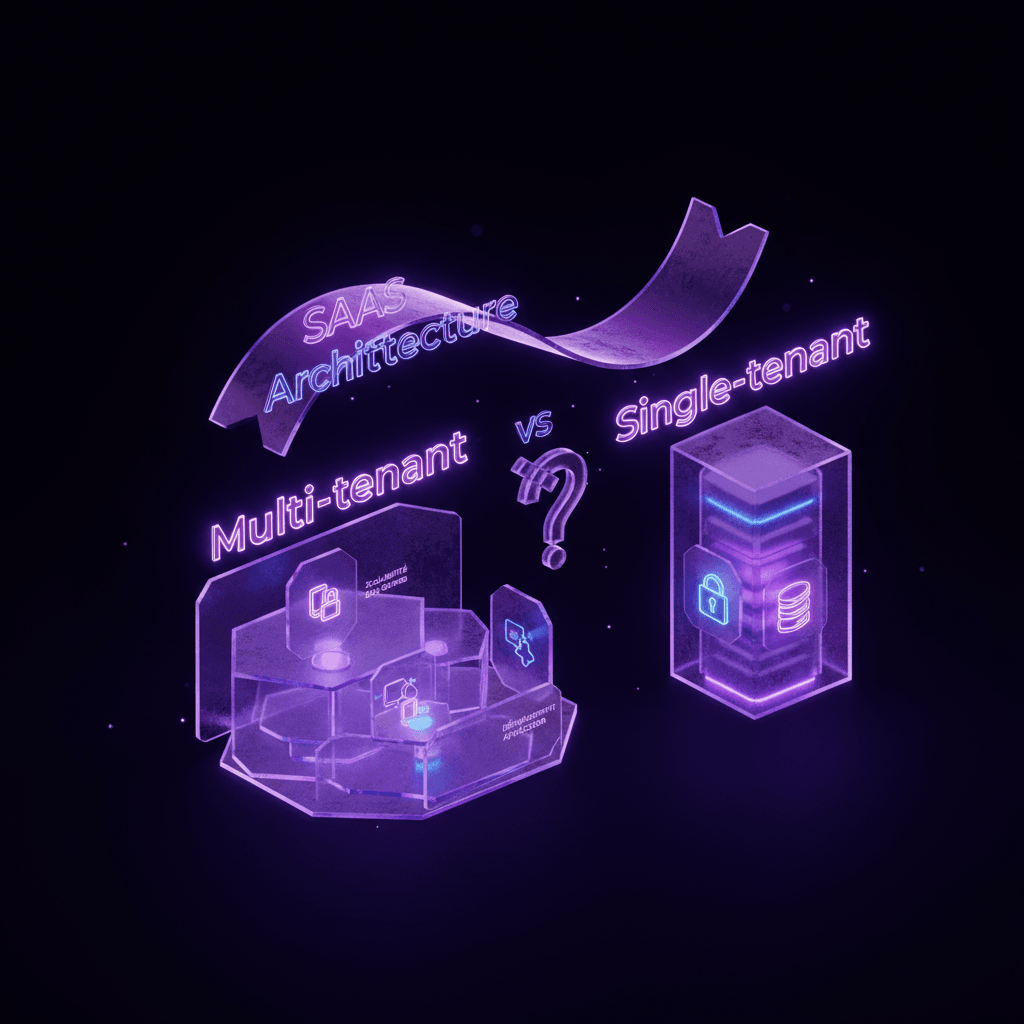
The multi-tenant architecture is a model where a single instance of the software, deployed on shared infrastructure, serves multiple clients (tenants). Each client uses the same application and database but their data is logically isolated from others. This is the dominant model for consumer SaaS like Slack, Dropbox, or Zoom. Isolation is achieved through identification keys (like a tenant_id in each table) or distinct database schemas (per-client schema method). The core code and resources are largely shared.
What is a Single-tenant SaaS Architecture?
The single-tenant (or multi-instance) architecture is a model where each client has its own dedicated instance of the software, often on separate infrastructure. This could be an isolated virtual machine, a container, or even a distinct Kubernetes cluster. The application and database are dedicated to a single client. Historically linked to "on-premise" hosted software or critical enterprise solutions, this model has evolved with the cloud to become more accessible. To fully grasp the implications of each model in an overall SaaS strategy, we recommend reading our guide on SaaS Architecture.
Comparison Table: Detailed Pros and Cons
Here's a summary table of the key aspects of both architectures, based on our 2026 experience and industry best practices.
| Criterion | Multi-tenant | Single-tenant | Clear Winner |
|---|---|---|---|
| Total Cost of Ownership (TCO) | Highly advantageous. Shared server resources, database, and maintenance. Reduced cost per tenant. | High. Each client requires dedicated resources. High cost per tenant, but linear. | Multi-tenant |
| Scalability (Horizontal) | Excellent. Resources (servers, databases) can be added to the shared instance to serve all clients. | Complex. Requires replicating resources for each new client (scaling by copy). | Multi-tenant |
| Security & Isolation | Depends on implementation. Theoretical risk of "noisy neighbor" or logical data leakage. Good with strict isolation. | Maximum. Physical/logical infrastructure is separate. Default isolation is best. | Single-tenant |
| Customization & White-labeling | Limited. Features are identical for all. UI customization is possible but complex for specific business modules. | Unlimited. Possibility to fork code, add specific modules, full branding. Ideal for tailor-made solutions. | Single-tenant |
| Maintenance & Deployment | Centralized. A single software update or security patch applies to all clients simultaneously. Maximum efficiency. | Decentralized and time-consuming. Each instance must be updated individually. Risk of version drift. | Multi-tenant |
| Performance ("Noisy Neighbor" Risk) | Potential slowdown if one client consumes too many resources. Requires quotas and fine-grained monitoring. | Predictable and guaranteed. One client's performance doesn't depend on others' activity. | Single-tenant |
| Regulatory Compliance | Challenges for sensitive data (health, finance). Requires proving logical isolation and sometimes offering specific geographic localization. | Easier to certify (HIPAA, GDPR, SOC2). Physical separation is a strong argument for auditors. | Single-tenant |
| Time-to-Market for New Client | Nearly instantaneous. The client is created by adding a database record (provisioning). | Slow. Requires deploying new infrastructure (VM, container, cluster), which can take minutes to hours. | Multi-tenant |
The Multi-tenant Architecture: The Standardized Market Model
Decisive Advantages of Multi-tenancy
The multi-tenant model has become the standard for large-scale SaaS for obvious economic reasons.
- Drastically Reduced Infrastructure Costs: A single PostgreSQL or MongoDB database hosted on a powerful server costs less than 100 small databases spread across 100 small servers. The economies of scale are enormous.
- Centralized Maintenance and Updates: Fixing a security bug or deploying a new feature is done once. For a product with 500 clients, this saves hundreds of operational hours annually.
- Simplified Horizontal Scalability: Facing increasing global load, you can simply add read replicas to your database or upgrade your application server, benefiting all clients simultaneously.
- Accelerated Development and Onboarding: The codebase is unique, simplifying development and testing. Provisioning a new client is a simple CRUD operation.
Challenges and Drawbacks of Multi-tenancy
Despite its advantages, multi-tenancy is not without its challenges, often underestimated during the design phase.
- "Noisy Neighbor" Risk: A malicious or simply very active client can monopolize resources (CPU, memory, disk I/O) and degrade performance for everyone else. This requires rigorous implementation of quotas, rate limiting, and monitoring.
- Complexity of Logical Data Isolation: A code error (a forgotten
WHERE tenant_id = ?) can lead to catastrophic data leakage. This isolation must be reinforced at all levels: ORM, API, cache. - Limited Customization: Offering radically different business workflows or modules for different clients becomes an architectural headache. Per-tenant "feature flags" can help but complicate the codebase.
- Regulatory Compliance: For sectors like healthcare (HIPAA) or finance, proving sufficient logical isolation to an auditor is more complex than physical separation. If you're just starting your project, our article Building a SaaS from A to Z covers this architectural choice from the very first steps.
The Single-tenant Architecture: Tailored Excellence for Critical Clients
The Strengths of Single-tenancy
The single-tenant model finds its relevance in contexts where requirements go beyond simple cost pooling.
- Maximum Isolation and Security: Physical/logical separation is the holy grail of security. An incident with one client (attack, data corruption) in no way affects others. This is a powerful selling point.
- Guaranteed and Predictable Performance: Resources are dedicated. You can sell solid performance guarantees (SLAs) without fear of interference.
- Unlimited Customization and White-labeling: You can create forks of your application for "enterprise" clients, add specific integrations, or profoundly modify the interface without impacting the common base. This is the ideal model for custom applications.
- Easy Migration and Offboarding: Migrating a client to their infrastructure or returning their data at the end of the contract is often simpler, as their data is already in an isolated silo.
Costs and Operational Challenges
Single-tenancy comes at a price, primarily operational.
- Exponential Infrastructure Costs: Each new client adds a significant fixed cost (server, database, licenses). This directly impacts your profit margin and may require higher pricing.
- Magnified Maintenance Burden: Applying a critical patch to 100 distinct instances takes 100 times longer than on a single multi-tenant instance. Automation (CI/CD, IaC) becomes not a luxury, but an absolute necessity.
- Version Drift: Some clients may refuse an update, forcing you to maintain multiple versions of your product in parallel – a nightmare for the development team.
- Complex Scalability: Scaling infrastructure must be done client by client, which is less efficient than scaling a centralized platform.
For projects requiring this level of customization and isolation, our Custom SaaS Application Development service can guide you in designing this robust architecture.
The Hybrid Model: The Best of Both Worlds?
Facing this dilemma, a third path emerges and gains popularity: the hybrid architecture. This often involves a multi-tenant application (shared code) coupled with a per-client database (single-tenant data).
Principle and Advantages of the Hybrid Model
In this model, all clients run the same application code, hosted on shared application servers. However, each has its own database (or its own schema within the same database instance). This approach offers:
- Enhanced Data Isolation: A SQL leak cannot expose another client's data because it's not in the same database. This significantly simplifies compliance.
- Centralized Application Maintenance: Code updates remain unique and instantaneous for everyone.
- Better Performance Management: Identifying a "noisy" client at the database level and assigning it dedicated resources if needed is easier.
- Deployment Flexibility: You can start with a single database (multi-tenant) for small clients and migrate large clients to dedicated databases (hybrid) without changing the application.
Disadvantages and Technical Complexity
This model is not a panacea. It adds a layer of complexity:
- Database Connection Management: The application must be able to dynamically route requests to the correct database based on the client.
- More Complex Provisioning: Creating a new client now involves creating a new database (or schema), with its migrations, backups, etc.
- Intermediate Cost: More expensive than pure multi-tenant (multiple small DBs), but less expensive than pure single-tenant (no application duplication).
The choice between PostgreSQL and MongoDB can influence this decision. Our comparison PostgreSQL vs. MongoDB for SaaS details how each database adapts to these isolation models.
Selection Criteria: How to Decide in 2026?
Given these options, here's a decision framework based on concrete criteria.
1. Market Segment and Client Size
- B2C Startups / SMBs: Your clients are numerous, with standardized needs and limited budgets. Pure multi-tenant is almost always the right choice for its cost-effectiveness and simplicity.
- Large Enterprises / Regulated Industries: Your clients are few but critical, with strong demands for security, customization, and compliance (banking, healthcare, manufacturing). Single-tenant or hybrid becomes justifiable, even necessary.
2. Regulatory and Security Requirements
- Non-sensitive Data / Standard GDPR: Multi-tenant with robust logical isolation (per-tenant schema, row-level security) is generally sufficient.
- HIPAA, PCI DSS, Health Data: Auditors often favor physical separation. Single-tenant or hybrid (dedicated database) will be your allies. Rigorous documentation of isolation controls is essential.
3. Customization and White-labeling Needs
- Standardized Product: If your value lies in a unique, identical user experience for everyone, multi-tenant is ideal.
- Tailored Offering / Platform: If you need to adapt workflows, integrate client legacy systems, or offer complete white-labeling, single-tenant provides unparalleled flexibility.
4. Budget Constraints and Business Model
- Freemium / Low-touch Sales Model: With thousands of users and low average revenue per user (ARPU), the operational efficiency and low per-client cost of multi-tenant are imperative.
- Enterprise Sales / High-touch: With multi-year contracts worth five or six figures, the extra cost of a dedicated instance is easily absorbed by the selling price and even becomes a selling point.
5. Technical Team Skills
- Small Team, Product Focus: A well-designed multi-tenant architecture (with a solid stack) requires less long-term operational effort.
- Mature DevOps Team, Strong Automation: A team capable of building a robust orchestration platform (with Kubernetes, Terraform) can efficiently manage hundreds of single-tenant instances, making this model viable. To make the right technical choice, our guide on How to Choose Your Tech Stack in 2026 will help you select technologies suited for your data isolation needs.
Conclusion
The choice between a multi-tenant and single-tenant architecture isn't binary but strategic. It directly stems from your value proposition, target market, and long-term vision.
- Favor multi-tenant if you aim for mass adoption, operational efficiency, and a standardized, highly profitable product. It's the royal road for most B2C and consumer SaaS B2B.
- Opt for single-tenant (or hybrid) if you target the enterprise market with strict security, compliance, and customization requirements. The additional cost is justified by the delivered value and selling price.
- Consider a hybrid evolution: You might start with pure multi-tenant to validate your market and acquire your first customers, while architecting your code to allow a future migration to a hybrid model for your premium clients.
In my role as Partner CTO at Aetherio, I regularly assist founders with this crucial decision. The key is not to get locked into an initial technical choice: a good architecture is, above all, scalable. Invest in clean, well-structured code and solid abstractions (like a "TenantContext" layer) from the start. This will give you the necessary flexibility to pivot or adapt your hosting model based on your clients' growth and feedback.
Your SaaS project deserves an architecture that supports its growth, not hinders it. If you're debating these models or considering a migration, let's discuss the best technical and business strategy for your product.
Further Reading:
- SaaS Architecture: The Complete Guide to Mastering Data Management and Strategic Issues in 2026
- Building a SaaS from Scratch: Stack, Architecture, and Launch in 2026